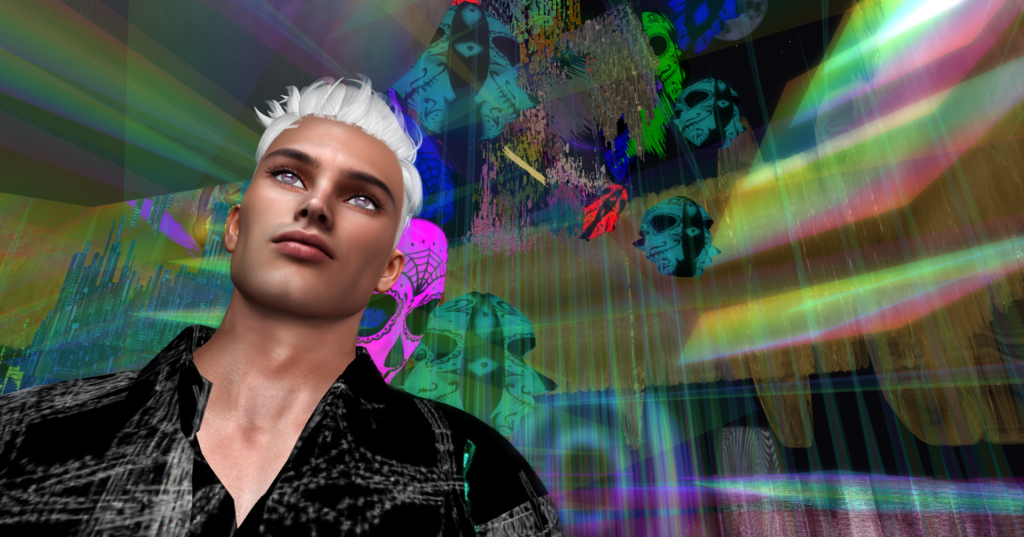
Nyx Breen is a photographer, digital artist, and creator of immersive virtual environments. For decades, he has explored visual storytelling through photography, combining atmosphere, narrative, and experimental imagery with a deep interest in perception, discovery, and human experience.
A long-time advocate for arts and culture, he is a member of the Revere Arts Community, founder of the Revere Public Arts Commission, and former Massachusetts TDI Adjunct Fellow, supporting initiatives that connect creativity, innovation, and community engagement.
Since the early days of virtual worlds, Nyx Breen has developed immersive artistic installations that merge photography, digital design, environmental storytelling, light, and virtual architecture. His work invites visitors to move beyond simply viewing images and instead experience art as a space for exploration, reflection, and discovery.
Within the Pangea Grid, Nyx Breen is widely recognized for his large-scale immersive environments and visionary artistic landscapes. Through the innovative use of virtual worlds, EEP environments, mesh deconstruction techniques, visual effects, and atmospheric design, he creates unique experiences that encourage visitors to explore, imagine, and engage with art in new ways.
Working at the intersection of photography, virtual art, and immersive storytelling, Nyx Breen continues to push creative boundaries, creating spaces where art is not merely observed, but fully experienced.
Between Photography and Immersion
A Conversation with Nyx Breen
Lampithaler: Nyx, what first attracted you to photography, and what continues to drive your creative pursuits today?
Nyx Breen: Decades ago, my parents had a strong influence on me. My father was a teacher and my mother a writer, and together they sparked my passion for film photography. Looking through photojournalism magazines such as National Geographic, Life, and Time, I became fascinated by the stories each image could tell. That fascination never really left me. Photography remains a way of exploring, communicating, and sharing stories with others.
Lampithaler: Your photographs often feel very atmospheric and immersive. What draws you most to certain moods, places, or moments?
Nyx Breen: For me, creating an image is about storytelling—stories that engage people and provoke thought.
After many decades of practicing photography, the process has become instinctive. I can walk into a space, recognize something visually compelling, and begin transforming it into a narrative. The goal is always to create an image that is both beautiful and intriguing, while inviting viewers to reflect and complete part of the story within their own imagination.
Lampithaler: How would you describe the connection between photography and virtual worlds?
Nyx Breen: Both photography and virtual worlds are driven by digital technology, but they are experienced differently.
Traditional photography, whether film-based or digital, ultimately relies on a format that most people already understand. Virtual-world photography, however, is created, displayed, compressed, and experienced through entirely digital environments.
What makes virtual photography exciting is the ability to manipulate elements that simply do not exist in physical reality. Changes in environmental settings, lighting systems, atmosphere, color depth, and visual effects can completely transform an image. Virtual worlds offer opportunities for experimentation that traditional photography cannot provide.
For me, the relationship between photography and virtual environments is a fascinating blend of two visual languages, each expanding the possibilities of the other.
Lampithaler: As Nyx Breen in OpenSim and virtual art spaces, what are you searching for—artistically or perhaps personally?
Nyx Breen: Honestly, for me it is primarily an artistic journey.
I entered virtual worlds in 2005 and participated in projects such as Through the Virtual Looking Glass in the early days of Second Life and the MIT virtual environments. I was fortunate to meet extraordinary creative people and develop my own artistic voice there.
Today, I sometimes feel that many people have forgotten what virtual worlds were originally meant to be: immersive experiences.
Too often the focus becomes shopping, clubs, relationships, or drama. People rarely pause to explore something new, visually unique, or intellectually inspiring.
What motivates me most is hearing someone arrive at one of my installations and say, “Wow!” or “How did you do that?” Those moments make everything worthwhile.
I strive to create immersive art that must be explored to be fully appreciated—works built from visual effects, EEP environments, and mesh deconstruction techniques that can only exist within virtual worlds.
Lampithaler: What does immersion mean to you beyond technology?
Nyx Breen: Imagine standing in front of a photograph and suddenly being able to walk into it.
That is immersion.
Virtual worlds transform a two-dimensional image into a three-dimensional experience. The X, Y, and Z axes become part of the creative process, opening entirely new possibilities.
This affects not only virtual art but also my real-world photography. The way I think about color, depth, composition, and atmosphere is influenced by both worlds. Each informs the other.
The only real limitations are technology—and imagination.
Lampithaler: Are there themes or emotions that unconsciously return again and again in your work?
Nyx Breen: Yes.
I often see people becoming absorbed by the experience itself. They find moments of reflection, comfort, or discovery.
At the same time, I enjoy presenting challenges. I want viewers to engage with the work rather than simply observe it. Exploration is part of the experience.
Lampithaler: What do you hope people feel or take with them after experiencing your work?
Nyx Breen: I hope they realize that art can be much more than they initially imagined.
I want people to look beyond the obvious—to explore beyond the club, beyond the shop, beyond the familiar places—and discover entirely new ways of seeing and experiencing creative spaces.
Lampithaler: And looking toward the future: what would you still love to create or explore artistically?
Nyx Breen: An Art Hub.
A place where artists, photographers, builders, musicians, and explorers can come together. A living environment dedicated to creativity, experimentation, and immersive experiences.
A place where art is not simply displayed—but discovered.